

When to put on the patch.
3 weeks on. 1 week off.
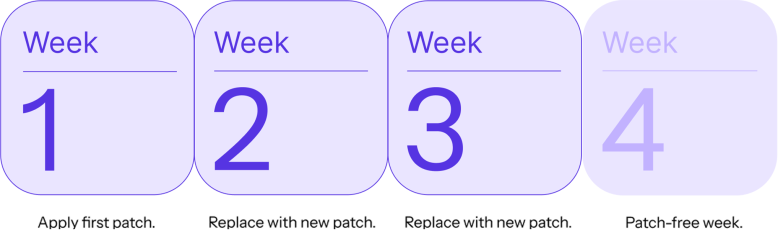
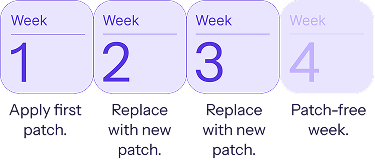
Pick when to start: Choose the same day each week to put on the patch. Set a reminder if you need to.
Check it: Check your patch daily and after any water exposure to make sure all edges are sticking correctly (so it works right).
Know when to use a backup: Depending on when you start the Gwyn Lo patch, you may need nonhormonal backup birth control, like condoms, for the first 7 days. If your patch is off for more than 7 days in a row, you could become pregnant.
For more details, see the Instructions for Use.
Where to place the patch.
Pick a spot. You've got 4 options.


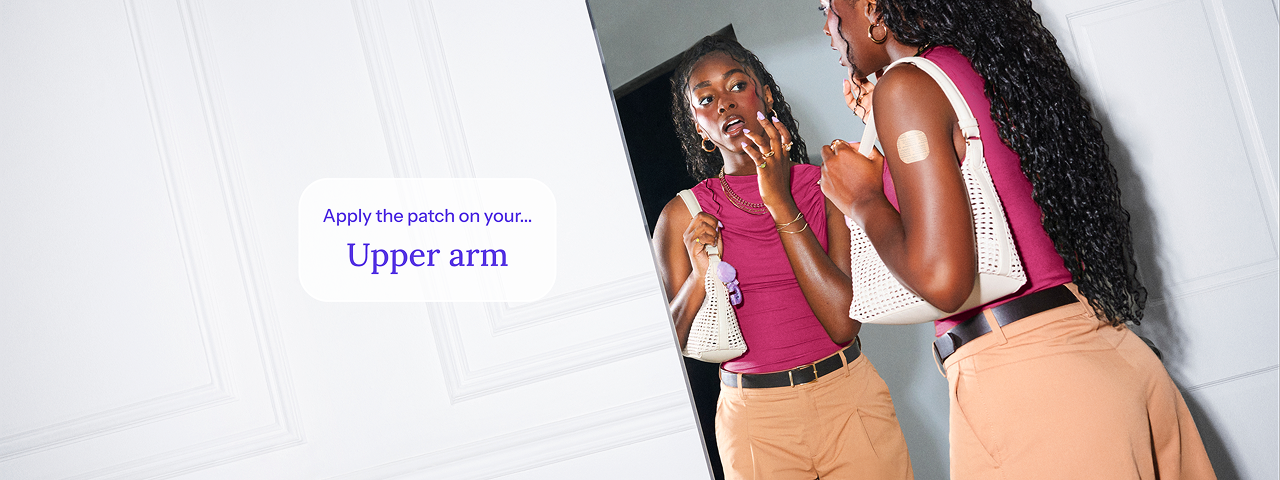

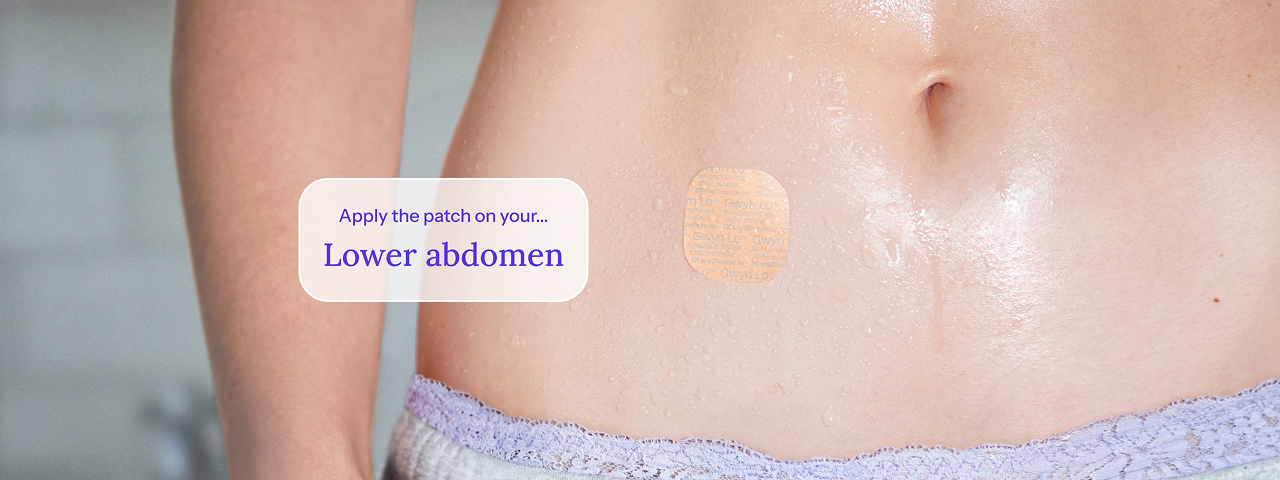
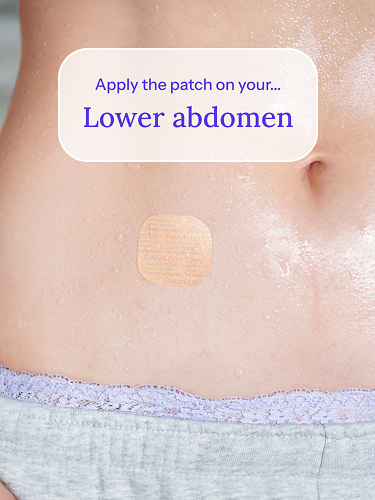
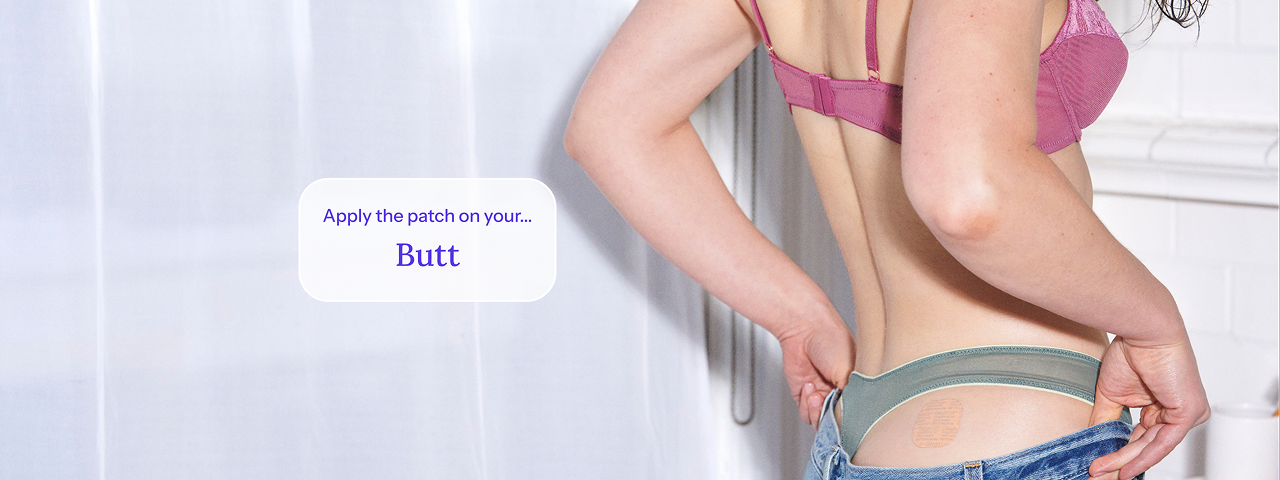

Switch it up: Don't put your patch on the same place as your last one—but you can use the same body part.
Skip these spots: Avoid sticking the patch on the breasts, cut or irritated skin, or areas where tight clothing may rub.
How to apply the patch.
Put it on and go.

Prep.
Pick a spot on your skin.
Make sure it's clean and dry.

Open.
Take the patch out of its pouch when you're ready to apply it. Peel off one half of the clear backing. Avoid touching the sticky side.

Press.
Place the sticky side on your skin and remove the other half of the clear backing. Press firmly on the patch with the palm of your hand for 10 seconds. Use your fingers to smooth out the edges.
Keep it clean: Apply the patch to clean, dry skin that has no powder, makeup, cream, oil, or lotion on it.
Don’t mess with the patch: Don’t cut or alter it. If it's not sticky, or it sticks to itself or something else, don't try to use it.
Do an edge check: The patch only works when it's fully stuck to your skin. Check it daily and after any water exposure (such as bathing or showering) to make sure all the edges are sticking correctly.
See the Instructions for Use for detailed step-by-step directions, and ask your doctor if you have any questions.
Changing the patch.
Peel it off.

Remove it.
Remove it after 7 days of wearing.

Replace it.
Replace it with a new patch, unless it’s your patch-free week.

Trash it.
Fold the sticky sides together, and place it in a child-proof container. Place the container in the trash.
Real talk: About side effects.
The safety of Gwyn Lo was studied in over 1200 women.
Serious side effects
Gwyn Lo may cause serious side effects, including blood clots.
Like pregnancy, hormonal birth control may increase the risk of serious blood clots, especially in women who have other risk factors such as smoking, high blood pressure, high levels of fat in the blood, diabetes, obesity, a family history of blood clots, or are older than 35 years old. This increased risk is highest when you first start using hormonal birth control and when you restart the same or different hormonal birth control after not using it for a month or more.
Some studies have reported that women who use norelgestromin and ethinyl estradiol transdermal system have a higher risk of getting a blood clot. Talk with your healthcare provider about your risk of getting a blood clot before using Gwyn Lo or deciding which type of birth control is right for you.
Most common side effects
The most common side effects of Gwyn Lo include:
- Skin irritation, redness, itching, or rash at the patch application site
- Bleeding between periods and heavy periods
- Nausea
How many women stopped Gwyn Lo due to side effects during the study?
- Overall, 7.2% of women stopped using Gwyn Lo because of side effects
- 1.6% of women stopped Gwyn Lo due to irregular or unusual bleeding/spotting
- The most common individual reason for stopping Gwyn Lo was skin irritation (1.2%)
- Less than 1% of women had severe skin reactions where their patch was placed
- Overall, 0.9% of women stopped Gwyn Lo due to mental health conditions
- Mental health conditions included depression, anxiety, suicidal ideation, altered mood, depressed mood, and irritability
- 0.2% of women stopped Gwyn Lo due to weight gain
These are not all the possible side effects of Gwyn Lo. See the Patient Information for more.
Call your doctor for medical advice about side effects. You may report side effects to the FDA at 1-800-FDA-1088.
Want to stop? Just take it off.
If you want to become pregnant, you can stop Gwyn Lo whenever you want. Consider a visit with your healthcare provider for a pre-pregnancy checkup before you stop using the patch.

You can stop Gwyn Lo anytime.

No removal or insertion procedures.

Have questions?
Consider talking to your doctor.
For more information about stopping Gwyn Lo, see the Instructions for Use.
Questions? Start here.
Here are quick answers to help you learn more.
Depending on whether you're starting Gwyn Lo as your first birth control or changing from another method, instructions may be different:
- Not on birth control: Start on day* 1 of your period or the first Sunday after that
- Pill, another patch, ring, or shot: Start on day* 1 of your next monthly cycle
- IUD or implant: Start on the day* your IUD or implant is removed
Use nonhormonal backup birth control (like condoms) for 7 days if you start any other day besides day 1 of your monthly cycle.
See the Instructions for Use for more information.
*Day=within 24 hours.
IUD=intrauterine device.
If you forget to change your week 1 patch:
- Put it on as soon as you remember—that day of the week will be your new patch change day
- Use a nonhormonal backup birth control (like condoms) for the next 7 days
If you forget to change your week 2 or 3 patch:
- Put it on as soon as you remember
- If you put it on within 2 days of your usual patch day:
- Your next patch should be applied on your usual patch change day
- No backup birth control needed
- If you put it on 2 days or more after your usual patch day:
- Start a new 4-week cycle by putting on a new patch
- That day of the week will be your new patch change day
- Use a nonhormonal backup birth control (like condoms) for the next 7 days
- If you forget to remove the patch during week 4 (patch-free week):
- Take it off when you remember
- Start your next cycle on your normal patch change day
- No backup birth control is needed
See the Instructions for Use and ask your doctor if you have any questions.
Yes. If you want to change your patch day, finish the first 3 weeks of your patch cycle. During your patch-free week, put on a new patch on your preferred day.
You should not go more than 7 days without a patch on..
See the Instructions for Use and ask your doctor if you have any questions.


Save on Gwyn Lo
Get a Gwyn Lo Savings Card.
*Not valid for Medicaid/Medicare. See the full Terms and Conditions.